
Thanksgiving: Remembering When I Got a Wake-Up Call on Healthcare Directives
By Mari Fries CFP® EA
10/28/2026
A Flight to Newport
I am writing this on a flight to Newport, Rhode Island, where my husband and I are about to watch our second son graduate from Officer Candidate School. As I look out the window, my mind keeps drifting back almost 5 years ago, to another moment when time stood still.
I want to say up front: My son and his friend are okay and doing well. Luke is about to become a Naval Officer. But the road here included a night we will never forget. Through this personal experience, my family was taught a lesson every parent, guardian, or loved one of a soon-to-be eighteen-year-old needs to hear.
Seven Days After His Eighteenth Birthday
Luke turned eighteen on March 12th. He was a senior in high school, waiting for college acceptance letters, enjoying that last easy stretch of being a kid. Seven days later, on March 19th, he was driving a friend home from the mall, making a left turn on a green arrow following a full stop at a red light, doing everything right, when a drunk driver ran through the red light and hit them head-on. The other driver was speeding down a hill, on a suspended license, in a car that was not even his.
The phone rang at eleven thirty that night. My son was being taken to the closest trauma hospital.
Standing Outside the ER, Powerless
We rushed to the hospital, still coming out of the pandemic, and were told almost nothing. They were running CT scans; he would survive, and he would eventually be sent to the observation floor. Visiting hours did not start until ten the next morning. My husband and I stood there realizing, in real time, that we had no legal right to information about our own high school-aged son. A week earlier, we could have been at his bedside and made every decision for him. Now we were provided limited information and told to return during visiting hours!
Unable to do anything else, we did the only thing we could do. We went to see his car at the tow yard. Ironically, although we thought of the car as Luke’s, the car was legally still ours. We had no problem accessing it. After providing our documentation of ownership, the tow yard attendant walked us to a vehicle and said, “Here it is”. In disbelief, I told the attendant, “That is not my car”. It was unrecognizable; the entire front end was crushed almost beyond description. My husband looked at me and said, “Mari, look at the plate! This is Luke’s car”. He was right; the license plate was a match. The tow yard attendant, a man who saw wrecked cars every day, asked if the people inside had actually survived. He assumed no one could have.
Remarkably, both boys had angels watching out for them. At ten am, we were finally allowed in to see Luke. Only one of us could go up at a time, another small reminder of where we stood. Luke had lost consciousness and suffered major bruising and was kept in the hospital for observation. He remembers very little of the accident itself, mostly the sound of a loud engine and the sight of headlights illuminating his car just before impact, followed by the smell of the airbags and, later, the ambulance.
A Senior Year Spent on Court Dates, Insurance and Medical Billing
The rest of Luke’s senior year was swallowed up by the aftermath. There was court, there was insurance, there was medical billing, and because he was legally an adult, it was largely his name on everything. Providers and insurers would still call me constantly, simply because his childhood contact information still listed my number everywhere. So I was fielding the calls without any standing to actually act on them. My own son would become frustrated when asked for information an adult should know. In his mind, he just wanted to enjoy his last year of high school. On several occasions, I would remind the person on the other end that they were dealing with a high school senior and that I would attempt to call him at lunch to remind him to reach out and grant me permission to act on his behalf. Everyone was especially empathetic as they apologized while simultaneously reminding me they were simply following the law.
With my other children, the shift to adulthood at eighteen was gradual. I handed off responsibilities slowly, at my own pace. With Luke, it happened overnight, in the middle of a crisis, with no warning and no paperwork in place to bridge the gap. He lost a piece of his senior year to it, a stretch of time that should have been spent on college decisions and being eighteen, not court dates, insurance calls, and medical billing.
Back on That Plane
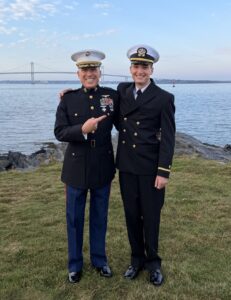
Luke with his Dad at Luke’s commissioning.
Which brings me back to this flight. Luke recovered. He finished high school, went on to study electrical engineering in college, and in a few days I will watch him commission as a naval officer. The boy who once rolled himself out of a crushed car is about to raise his right hand and take an oath to serve our Nation. When I think about how easily that night could have gone differently, and how unprepared we were for even the version of it we got, it puts this trip in a different light entirely.
Do Not Wait
As a comprehensive financial planner, I now build this conversation into every family plan when a client has a child turning eighteen. A healthcare directive and a durable power of attorney are simple documents. They take an afternoon, not a crisis, to put in place. But once your child turns eighteen, you are legally a stranger to their medical information and decisions unless those documents say otherwise, no matter how involved you have been in their life up to that point!
I do not say this to frighten anyone. I say it because we stood outside a hospital emergency room not knowing the gravity of our son’s situation, unable to get a clear answer, simply because the paperwork was not completed. If your child is about to turn eighteen, or already has, do not wait for a reason to get it done. Get it done so you never need a reason.